Army Corps of Engineers Grants Federal Permit for Line 5 Tunnel Under Straits of Mackinac
The U.S. Army Corps of Engineers approved the last federal permit needed for Enbridge's Line 5 tunnel project, even as a Michigan Supreme Court ruling requires state regulators to redo their own environmental review.
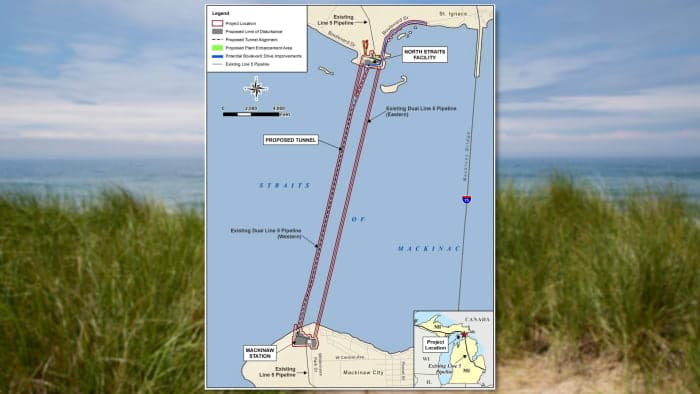
The U.S. Army Corps of Engineers approved a federal permit Wednesday clearing the way for Enbridge Inc. to build a 3.6-mile tunnel beneath the Straits of Mackinac to house a replacement for its Line 5 pipeline, closing out the last federal review the Canadian energy company needed before construction could begin.
The approval, issued by the Corps' Detroit District, came with a formal statement from Detroit District Commander Lt. Col. Donald K. Lew, who called it "the culmination of a robust and thorough evaluation process." Lew said his team worked with federal and state resource agencies, tribal nations and Enbridge itself before signing off. "I am confident that we have granted authorization for a thoroughly vetted proposal that will meet the purpose and need for the project while maximizing protection of natural resources," he said.
Line 5 carries light crude oil and natural gas liquids 645 miles from Superior, Wisconsin, to Sarnia, Ontario. At the Straits, the pipeline splits into two 20-inch segments that run along the lakebed for roughly 3.7 miles, at depths reaching about 240 feet, according to the Corps. Enbridge wants to replace that open-water stretch with a single pipeline encased in a concrete tunnel drilled into bedrock beneath the lakebed. The company has argued the design would eliminate the risk of an anchor strike or other impact rupturing the line.
Enbridge filed permit applications with state and federal regulators in April 2020. The proposal drew sustained opposition from environmental groups and tribal nations, who argued the tunnel and its construction could still damage wetlands, fish habitat and water quality in the Straits, and that the project ran afoul of the Michigan Environmental Protection Act.
The federal approval comes amid a dispute that remains unresolved at the state level. Michigan's Department of Environment, Great Lakes, and Energy and the Department of Natural Resources approved two state environmental permits for the tunnel last month, following what regulators described as an extensive review that included environmental assessments and public hearings. Those permits came with conditions attached.
Less than two weeks later, the Michigan Supreme Court upended that approval. In a 6-1 decision, the court found that state regulators had not adequately evaluated the project's environmental impacts before signing off. The ruling sends the matter back to the Michigan Public Service Commission, which must now reexamine Enbridge's proposal before any construction can proceed, regardless of what federal or other state agencies have approved.
That sequencing means the Army Corps permit does not clear Enbridge to start digging. The company still needs the commission's renewed approval, and opponents of the project have said they intend to keep pressing their case through that process.
Whitney Gravelle, president of the Bay Mills Indian Community, was among those who welcomed the state court's ruling and made clear the fight over the tunnel isn't over just because federal regulators have acted. "The Straits of Mackinac are not simply a route for an oil pipeline to be abused," Gravelle said. "They are sacred waters, the heart of creation for Anishinaabe people, and a source of life for millions. Some things are simply too sacred to be buried beneath a tunnel. Our work continues, and we remain committed to protecting the Great Lakes for generations to come."
The Straits of Mackinac connect Lake Michigan and Lake Huron. Enbridge has operated the existing dual pipelines there since the 1950s, and opponents of the project have pointed for years to the age of the infrastructure and past incidents elsewhere on the Line 5 system as reasons to shut it down rather than replace it. Enbridge and its supporters, including labor groups tied to pipeline construction, have argued the tunnel is a safer long-term fix that keeps propane and other fuel supplies moving to Michigan's Upper Peninsula and beyond.
The federal permit process alone took more than six years, from Enbridge's initial application in April 2020 to Wednesday's decision. Now that the Corps has acted, attention shifts back to Lansing, where the Public Service Commission has to decide how it will reevaluate the environmental record the Supreme Court found insufficient. No date has been set for when that reconsideration will conclude, and until it does, Enbridge cannot break ground on the tunnel no matter what federal paperwork it holds.